Showing posts with label Ironstone. Show all posts
Friday, March 18, 2011
Friday, March 11, 2011
Monday, March 7, 2011
It's a sickness, really
My ability to keep my ironstone hunting to a minimum is failing me. Worse, I've never been attracted to anything but plain 'ol white, until I found this. Now I have another pull...
It's American, 1880s-ish, and produced by WB & Co (William Brunt, Jr) in Liverpool, OH. Luckily for my budget (and I should note this little covered casserole was inexpensive because it is not simply white), finding any matching pieces will be very difficult. The potter was only in business for several years.
If for no other reason than I find it fascinating, here's a little bit about the history of this potter:
In 1866 Thomas Starkey and Nathanial Simms built a two kiln stoneware plant on West Market Street (now Dresden Avenue). Mr. Starkey withdrew from the plant in 1868 and Homer Laughlin joined Mr. Simms. At that time the pottery was known as N. M. Simms and Company. When Homer Laughlin left the company Mr. Ferguson joined with Mr. Simms. By 1875 the plant was closed and sold at Sheriff's sale.
William Brunt, Jr. was the successful bidder and named the pottery the "Dresden Pottery Works". He planned to manufacture Ironstone China. Joining him in the company were his brother Henry Brunt, his brother-in -law, William Bloor, George Martin and Samuel Emery. The company became known as the "Brunt, Bloor, Martin & Company." Mr. Bloor was the first in the city to make whiteware back in 1861, so they continued with the whiteware. The First kiln of the ware was in February 1876. The company produced excellent white ironstone , gold decorated ware, table ware, tea sets, spittoons, toys and double -thick hotel ware. It was that year, that the company went into competition with other white ware manufacturers at the Centennial Exposition in Philadelphia, Pa. Along with the other companies of the East Liverpool area, they received medal for excellence in production- -The "Highest Award and Diploma of Merit for white granite ware".
In 1876 the company was producing about 780 casks of ware and by the end of the decade they were producing 3000 casks yearly. The production increased each year until 1882 when a lock-out took place in the local potteries.
During the summer and fall of 1881, a lodge of "Knights of Labor" was organized in town. The pottery leaders were greatly opposed to this organization. in any of their potteries. The Boss Potters posted a resolution on the 17th day of June 1882, that members of the Knights of Labor would no longer be employed. This became a contest of boss potters against workers. The workers did not go to work and would not leave the Knights of Labor. Finally, the workers went back to work after 39 weeks when they signed the Manufacturers' "Iron Clad Agreement" which stated they would not belong to the Knights of Labor. The men lost this contest, but in the long run, the manufacturers also lost and the community was the biggest loser. Business and Real estate values suffered and the division of labor and management greatly widened.
Within a short time of the "Iron Clad Agreement" the owners of the Dresden Pottery Works sensed a change in the labor contracts and they decided to sell the pottery The company was sold to a group of workmen headed by H. A. McNicol. The potters purchased 3/4 interest in the plant and Mr. Emery kept the remaining 1/4 interest.This article, by Joan Witt, continues here.
Friday, March 4, 2011
All things white and beautiful
Ever since I was old enough to care about such things, I have loved simple white dishes. When C and I got married, one of my favorite wedding gifts was a large set of white dinnerware with a fruit relief pattern. Since then, I have accumulated other white dishes, from vintage ironstone to CorningWare's French White bakeware. I love it all.
Unfortunately, almost anything I have that's breakable has been packed away for at least a couple of years. Our kitchen wasn't big enough to stash it anywhere safe, let alone display it. For years I'd had our wedding dishes displayed on an open-shelved hutch, but when our family started *really* growing, I gave a bunch of the dishes to my sister and packed away the rest. The beautiful old china I inherited from my great aunt has been sitting in a china barrel since we moved into this house almost 8 years ago. It's a travesty, really.
In our new kitchen, we have enough space available that I could have two whole cabinets for display (plus the small, glass door cabinets on top of the tall uppers), and we'll have the new china cabinet in the dining room. I am really looking forward to being able to get out my white (and other) dishes and having somewhere safe for them to reside. I also look forward to USING them again! I can't wait to see them stacked and arranged on my shelves.
I've been scoping out new (to me) ironstone pieces and have a few things coming to join in the fun. :o) I can't afford anything perfect, but really, I don't mind the glaze pops and discoloration and crazing so much anyway. A lot of this stuff is 100-180 years old. If an item looks perfect, it's been in a box with no one enjoying it. If it's a little worn, I can imagine the meals and hands and washing and boo-boos that have been a part of its life. I'm not a hugely sentimental person, but for some reason, knowing that so many other wives/mothers have used, abused and treasured these items makes them really matter to me.
Here are three interesting things I have coming:
Can you imagine all the things this bowl has held? It makes me think of mashed potatoes, but it's probably held everything from apples to keys to a sick kid's barf! It's a J&G Meakin bowl from about 1890.
This one is a Johnson Bros pitcher, ca 1883-1913. I just thought it was purty, but it could make an awesome receptacle for our ginormous collection of chopsticks. ;o)
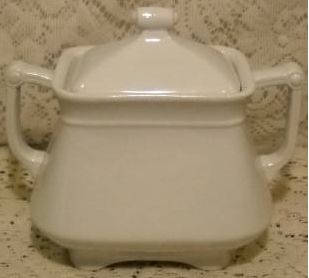
And this little sugar bowl is so sweet! I think I'll hide my packets of Truvia inside it since they tend to disappear inexplicably. If this were in good shape, it would have been way out of my price range, but thanks to a little chip on the lid, I paid $14.00. It's an 1880s Anthony Shaw piece.
Unfortunately, almost anything I have that's breakable has been packed away for at least a couple of years. Our kitchen wasn't big enough to stash it anywhere safe, let alone display it. For years I'd had our wedding dishes displayed on an open-shelved hutch, but when our family started *really* growing, I gave a bunch of the dishes to my sister and packed away the rest. The beautiful old china I inherited from my great aunt has been sitting in a china barrel since we moved into this house almost 8 years ago. It's a travesty, really.
In our new kitchen, we have enough space available that I could have two whole cabinets for display (plus the small, glass door cabinets on top of the tall uppers), and we'll have the new china cabinet in the dining room. I am really looking forward to being able to get out my white (and other) dishes and having somewhere safe for them to reside. I also look forward to USING them again! I can't wait to see them stacked and arranged on my shelves.
I've been scoping out new (to me) ironstone pieces and have a few things coming to join in the fun. :o) I can't afford anything perfect, but really, I don't mind the glaze pops and discoloration and crazing so much anyway. A lot of this stuff is 100-180 years old. If an item looks perfect, it's been in a box with no one enjoying it. If it's a little worn, I can imagine the meals and hands and washing and boo-boos that have been a part of its life. I'm not a hugely sentimental person, but for some reason, knowing that so many other wives/mothers have used, abused and treasured these items makes them really matter to me.
Here are three interesting things I have coming:
Can you imagine all the things this bowl has held? It makes me think of mashed potatoes, but it's probably held everything from apples to keys to a sick kid's barf! It's a J&G Meakin bowl from about 1890.
This one is a Johnson Bros pitcher, ca 1883-1913. I just thought it was purty, but it could make an awesome receptacle for our ginormous collection of chopsticks. ;o)
And this little sugar bowl is so sweet! I think I'll hide my packets of Truvia inside it since they tend to disappear inexplicably. If this were in good shape, it would have been way out of my price range, but thanks to a little chip on the lid, I paid $14.00. It's an 1880s Anthony Shaw piece.
A little ironstone eye candy, in closing...
Subscribe to:
Posts (Atom)